The Loss You Don't See Until It's Too Late
A farmer in rural Montana wakes up on a Tuesday morning to find that deer have worked through his alfalfa field overnight. The damage is visible. The timing is not — he doesn't know whether this has been happening for three nights or three weeks, whether it's a single animal or a herd, whether the entry point is the northwest fence line or the irrigation gate on the east side.
He sets a trap. He walks the perimeter. He finds tracks. He still doesn't know when they're coming, which means he can't intercept them, can't reinforce the right section of fence, can't make an informed decision about whether to invest in deterrence or accept the loss as seasonal.
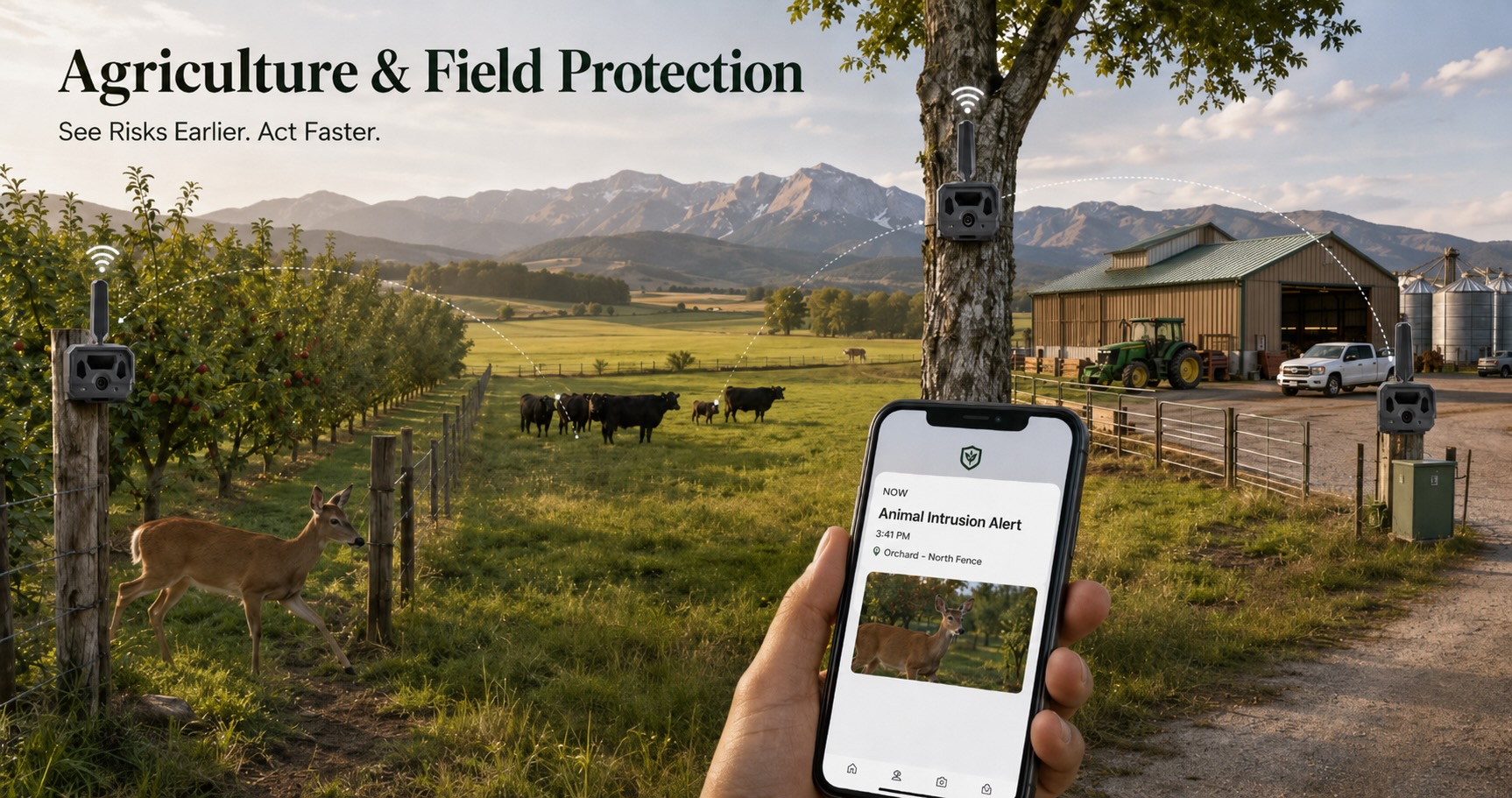
A cellular trail camera on that fence line would have told him on the first night. Species confirmed. Entry point identified. Time of entry logged. Alert on his phone at 2am — not at 7am when he finds the damage.
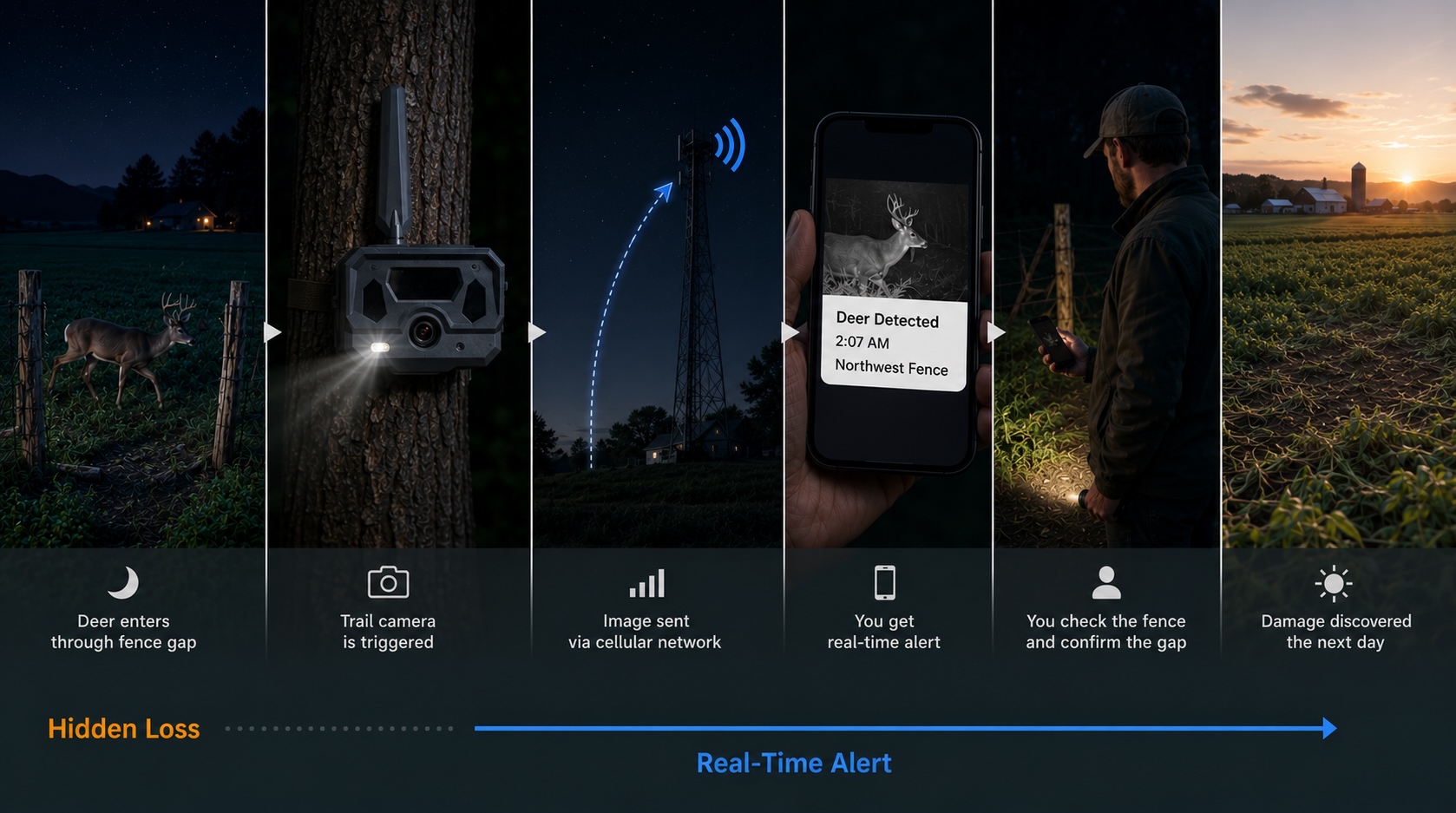
This is the core value proposition of remote monitoring in agricultural contexts: not surveillance for its own sake, but the conversion of invisible losses into visible, timestamped, actionable events. The moment a threat becomes known is the moment a response becomes possible. Every hour between the event and the discovery is an hour of continued loss and a narrowing window for effective intervention.
For OEM brands serving agricultural buyers — farm supply distributors, rural hardware retailers, livestock and property management companies — this is the problem the product solves. Not a camera. A loss prevention system that happens to be built around a camera.
Why Agricultural Monitoring Is a Harder Problem Than It Looks
The farm and field monitoring context imposes constraints that consumer trail cameras are not designed to handle and that urban security cameras cannot be adapted to address.
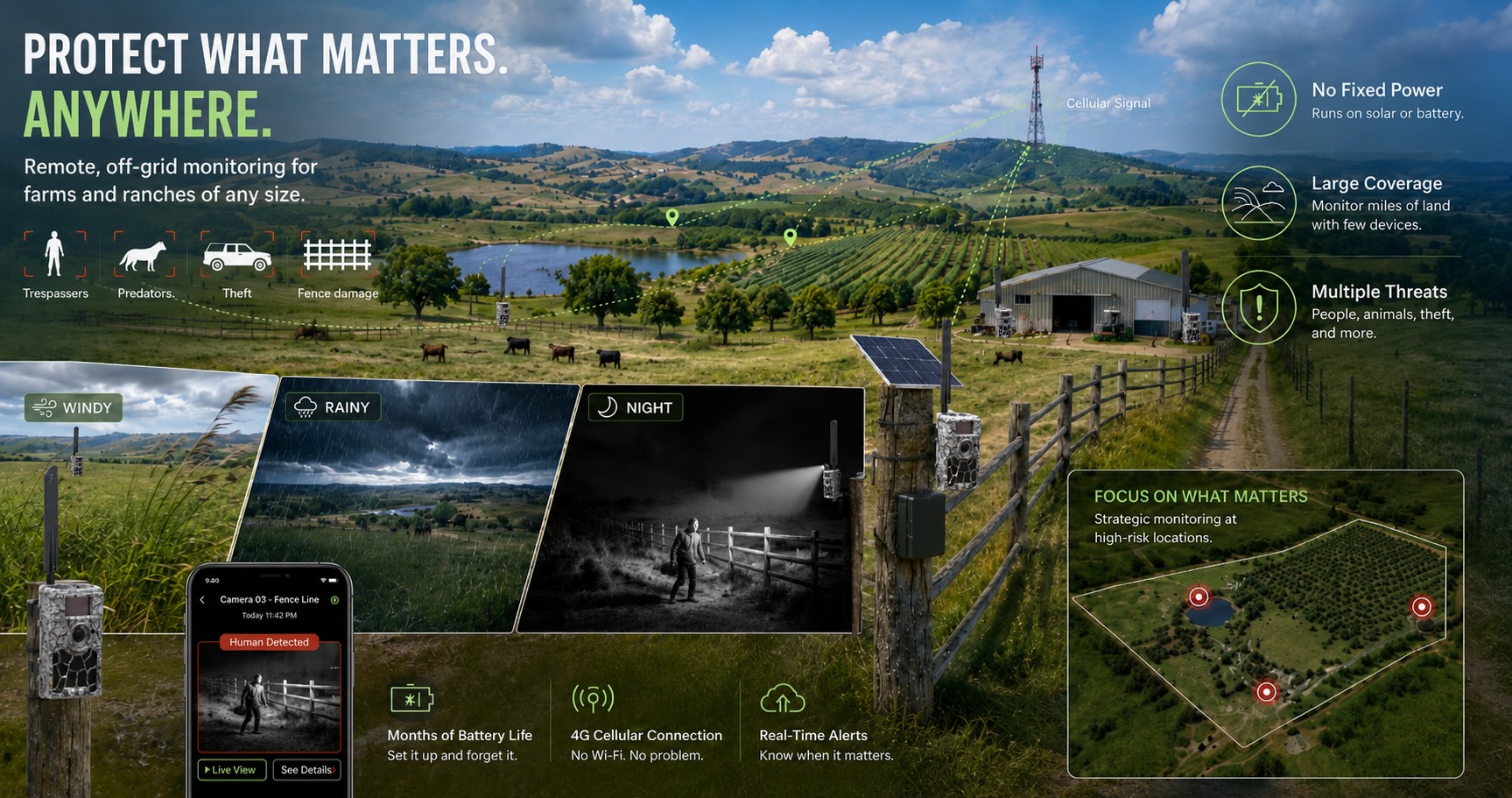
There is no power infrastructure where the threat is. The northwest fence line where deer are entering is not 20 meters from an outlet. The remote pond where poachers are taking fish at night is not wired. The orchard block where bear activity has been reported is not lit. Agricultural monitoring requires hardware that operates entirely on battery or solar power, maintains cellular connectivity across rural network coverage, and survives the temperature and weather conditions of working farmland across all seasons — not just the ones where conditions are favorable.
The monitored area is too large for fixed infrastructure. A 1,000-acre ranch cannot be covered by a wired camera system at any reasonable cost. The monitoring solution has to be deployable at specific high-risk points — water sources, fence crossings, feeding areas, storage perimeters — without requiring installation infrastructure at each location. It has to be relocatable when the threat pattern changes, which it does seasonally and situationally.
The buyer is not a security professional. Farm operators evaluating remote monitoring equipment are evaluating it against their time and their operational budget, not against an IT procurement checklist. A system that requires complex configuration, generates constant false alerts from wind-blown vegetation, or demands frequent battery replacement visits will be abandoned — not because it doesn't work, but because the maintenance overhead exceeds the value it delivers.
The threat profile is heterogeneous. Agricultural monitoring targets wildlife intrusion, human trespass, equipment theft, and environmental events — often at the same location. A trail camera on a grain storage perimeter needs to distinguish between a deer triggering the sensor and a person approaching at 3am. A camera at a remote water point needs to document both the coyote that killed a calf last week and the truck that has appeared twice after dark.
These constraints define the product requirements that Willfine's agricultural monitoring platform is built to address.
Four Threats, One Platform
Agricultural operations encounter four distinct threat categories that remote monitoring can address. The camera hardware is the same across all four — what changes is placement logic, transmission configuration, and alert setup.
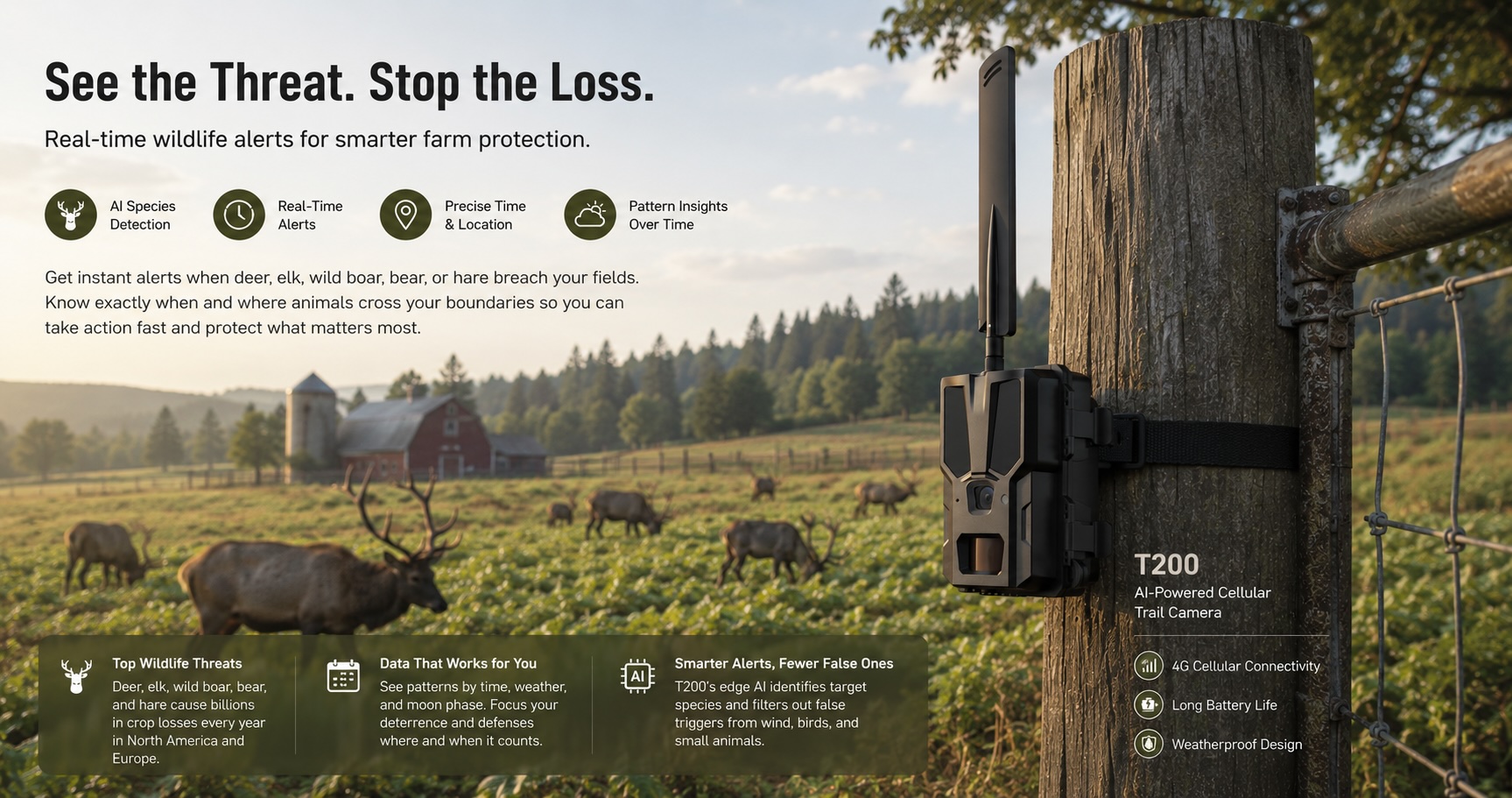
Wildlife intrusion and crop protection Deer, elk, wild boar, bears, and rabbits represent the most economically significant wildlife threat to agricultural operations across North America and Europe. The annual cost of wildlife crop damage in the United States alone is estimated in the billions of dollars — the majority of it occurring at night, at field perimeters, in locations that are not visually accessible from farm buildings.
A cellular trail camera deployed at the fence line or field edge converts that invisible overnight activity into a real-time alert with species identification, timestamp, and entry point documentation. Over a season, the accumulated image record reveals patterns — which nights, which weather conditions, which lunar phases correlate with intrusion events — that allow a farmer to concentrate deterrence effort where and when it will be most effective.
The T200's AI subject classification adds a layer of filtering that matters in high-trigger environments: a camera on a crop field edge may trigger hundreds of times per week on vegetation movement, small animals, and birds. AI classification that identifies deer and flags them specifically — while logging but not alerting on other triggers — reduces the notification volume to the events that require a response.
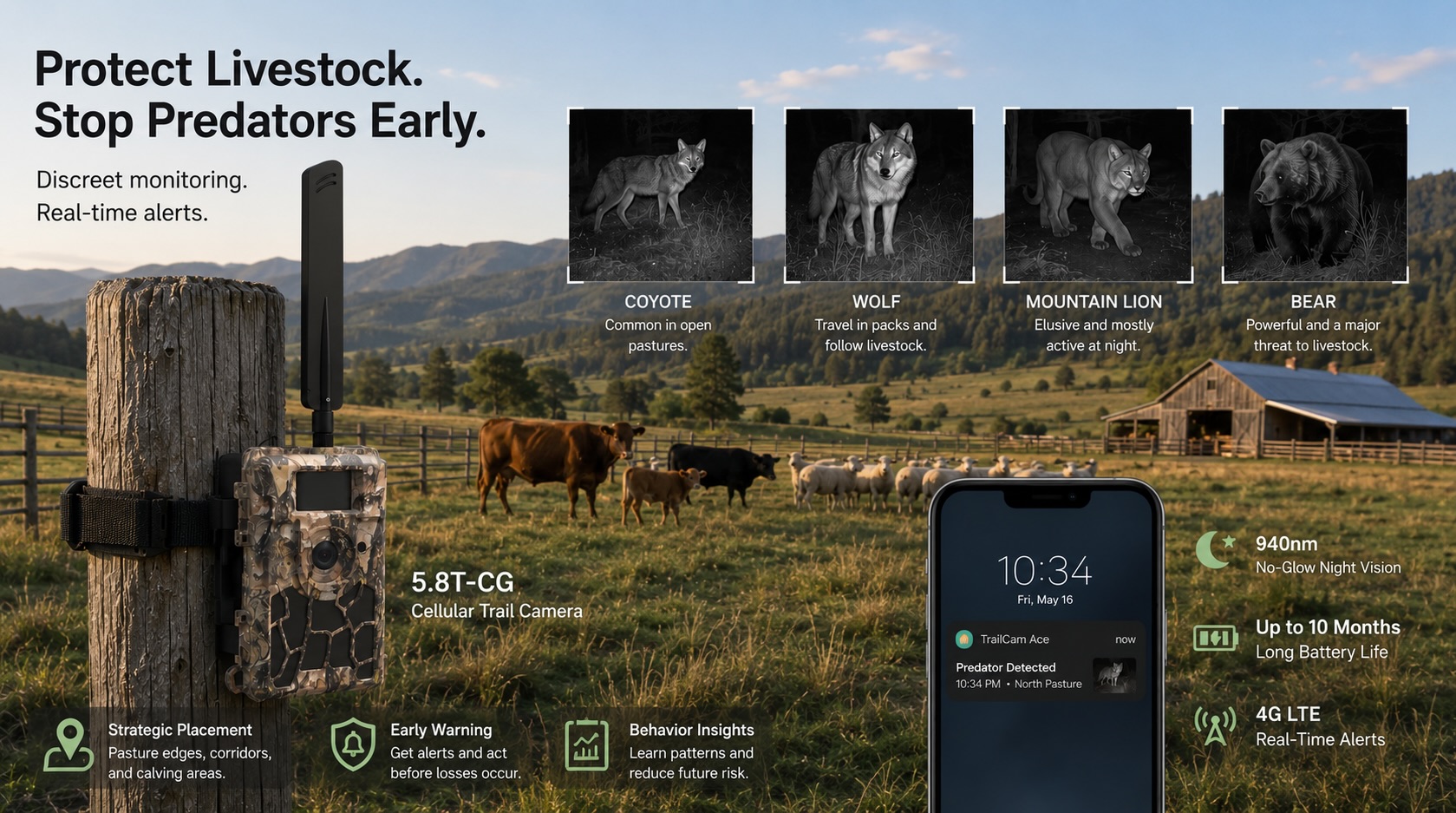
Livestock predator monitoring Coyotes, wolves, mountain lions, and bears represent a direct mortality threat to cattle, sheep, and poultry operations. The challenge for livestock operators is that predator activity is nocturnal, geographically distributed across large grazing areas, and unpredictable in timing and location — making conventional patrol monitoring labor-intensive and rarely effective.
A camera network deployed at the perimeter of grazing areas, at known predator entry corridors, and near vulnerable livestock concentrations provides the early detection that allows operators to respond before losses accumulate. The 940nm no-glow infrared across Willfine's lineup ensures that predators approaching a monitored zone are not alerted to the camera's presence — preserving the natural behavior pattern that the monitoring is designed to document.
The 5.8T-CG's approximately 10-month battery standby on 8 AA batteries is directly relevant here: remote grazing perimeters where battery replacement requires significant travel time benefit from the longest possible maintenance interval between site visits.
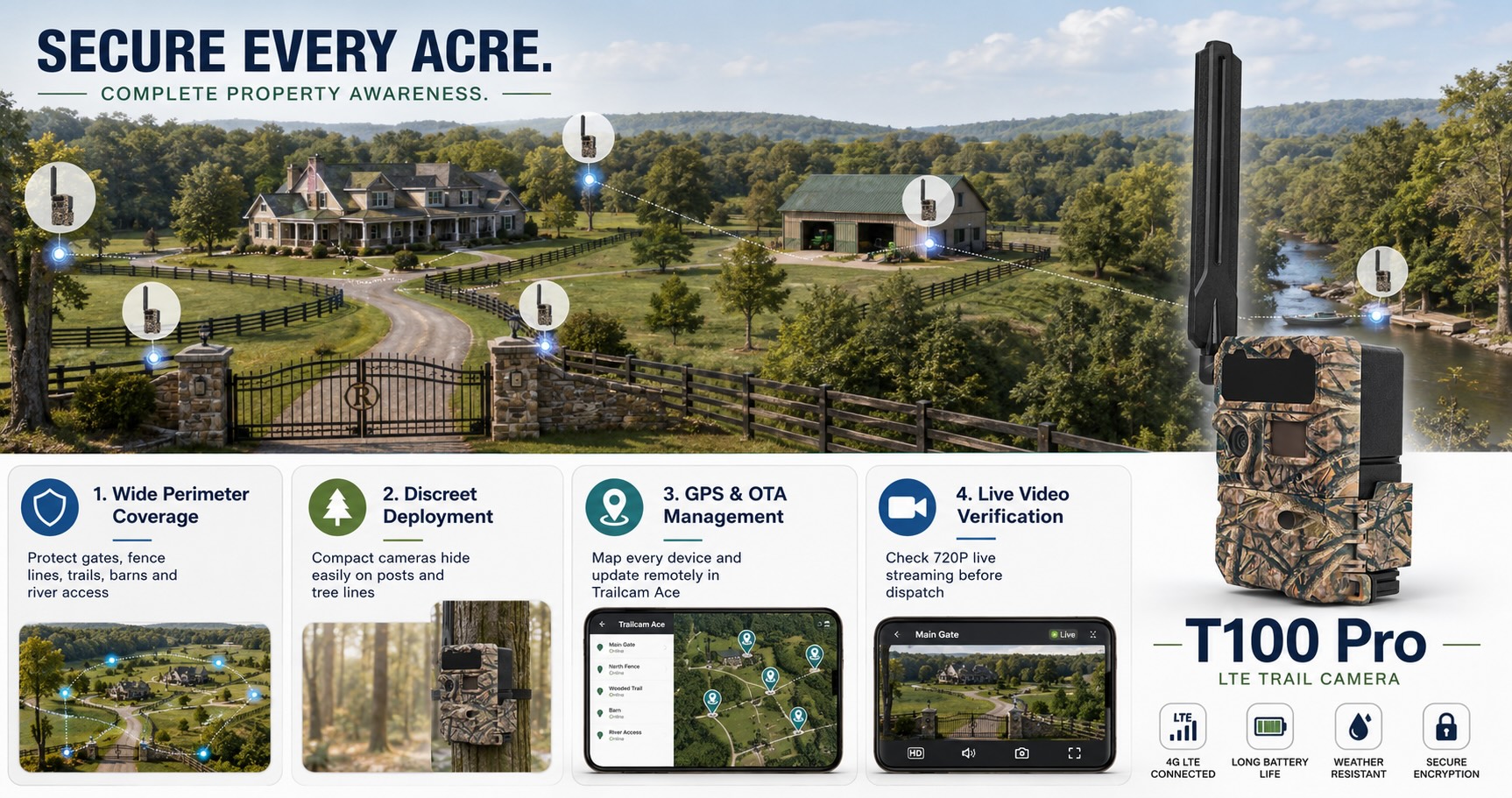
Equipment and property theft Agricultural equipment theft is a growing problem across rural North America and Europe. Tractors, ATVs, irrigation equipment, diesel tanks, and stored grain represent high-value targets in locations that are routinely unattended overnight and on weekends. The geographic isolation that characterizes agricultural operations — the same isolation that makes them attractive targets — also makes conventional security measures impractical.
A cellular trail camera deployed at equipment storage areas, fuel storage, and facility access points provides real-time documentation of approach and entry events. The 4.0T-CS's on-demand HD photo request capability is directly relevant in this context: a low-resolution alert image confirms human presence; an HD request captures the license plate, face, or equipment identification detail that supports law enforcement follow-up.
For OEM buyers, the theft prevention application expands the agricultural monitoring product's addressable market beyond farmers to rural property owners, weekend property managers, and remote facility operators — all of whom share the same monitoring challenge and can use the same hardware solution.
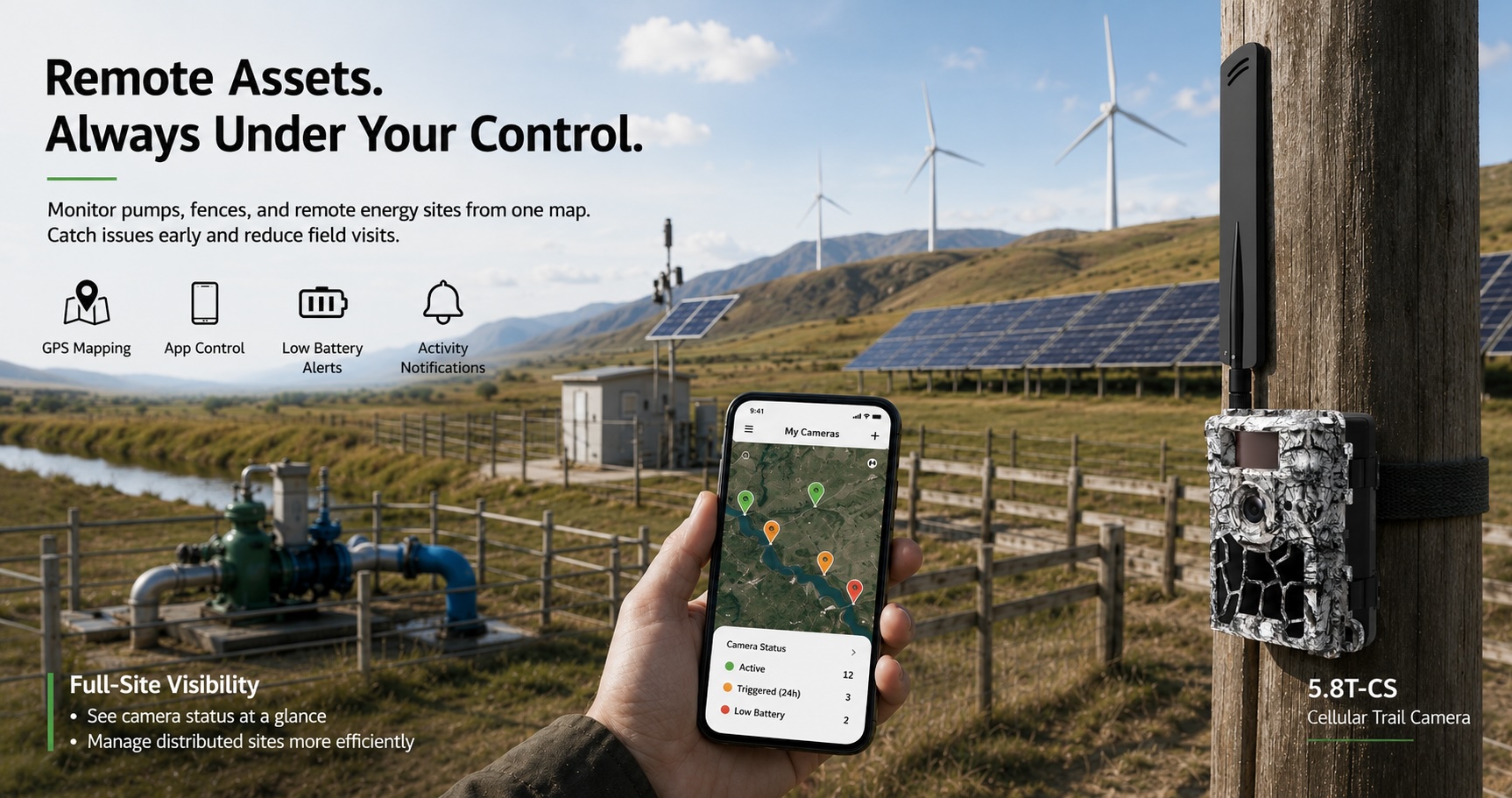
Remote facility and infrastructure monitoring Irrigation systems, pumping stations, water rights monitoring points, remote power generation equipment, and fencing across large properties all benefit from camera coverage that documents both operational status and unauthorized access. For operations that manage multiple remote facilities across large territories — large ranches, timber operations, water utility right-of-ways — the ability to visually confirm the status of a remote installation without a site visit has direct operational cost implications.
The 4.0P-CS and 5.8CS, with their app-connected remote management and GPS location mapping, enable a land manager to see the operational status of every camera in a distributed network from a single interface — which cameras are active, which have triggered recently, which may need attention — without driving the territory to check each one physically.
The Solar Equation: What It Changes for Agricultural Deployment
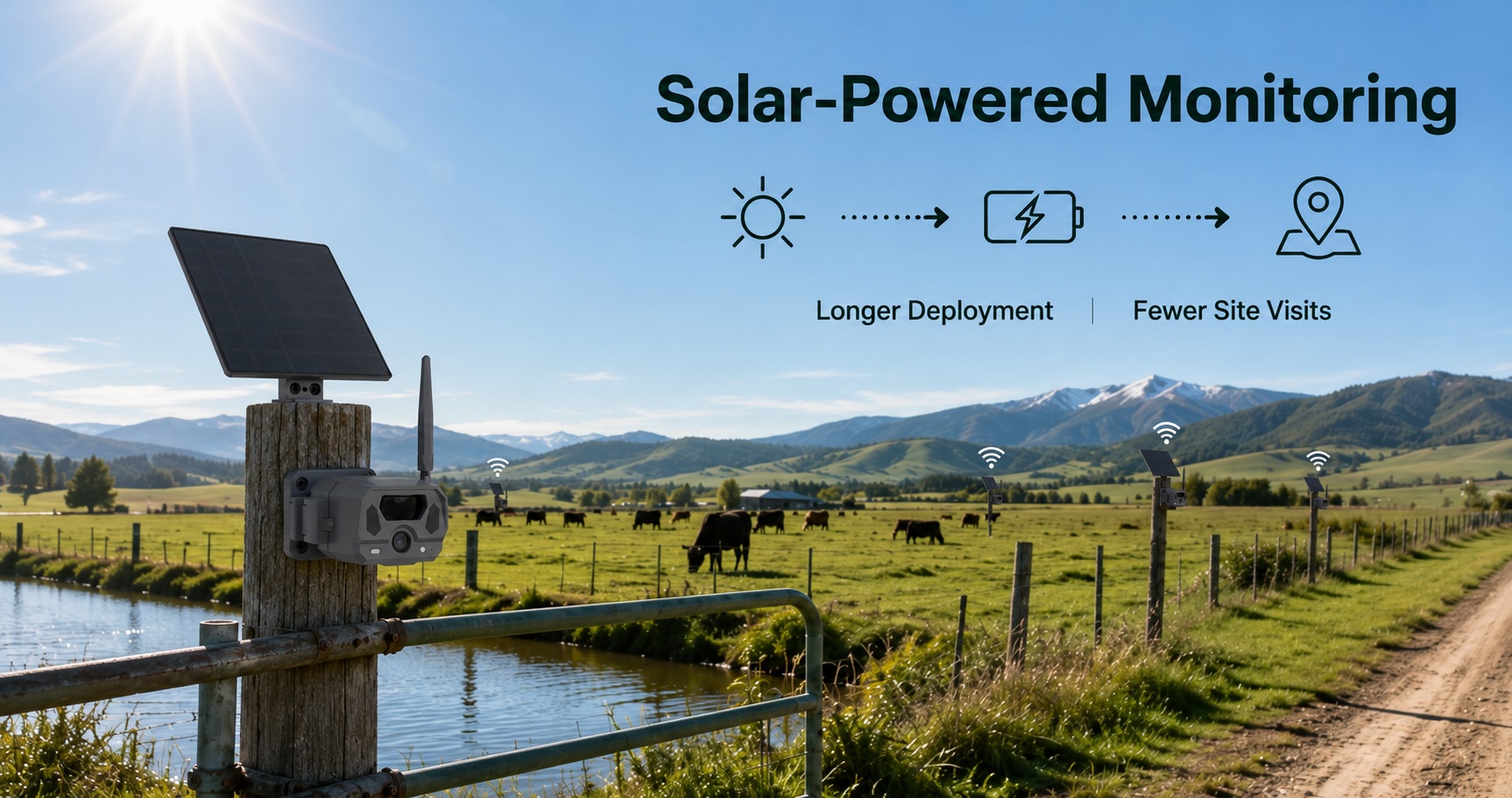
Battery replacement is the operational constraint that most consistently limits the scale at which agricultural users deploy trail cameras. A farmer who would deploy 15 cameras across a large property deploys 6 because managing battery replacement across 15 locations is not sustainable alongside a full farming workload.
Solar charging fundamentally changes this calculation. A camera that generates its own power from a solar panel — sized appropriately to its cellular transmission frequency and trigger rate — removes battery replacement from the ongoing operational burden. The initial deployment is the primary labor event. Subsequent site visits are for camera repositioning as threat patterns change, not for battery management.
The K600's integrated 5W solar panel paired with 5000mAh battery is designed for exactly this deployment model — and while the BK series is primarily positioned for birdwatching, the same hardware applies to any agricultural monitoring context where a feeder station, watering point, or fixed observation location needs continuous coverage without power infrastructure.
For the trail camera lineup, solar panel compatibility is available as an accessory across the platform — enabling the same deployment model at field perimeter locations where the camera is fixed and the monitoring priority is sustained coverage over maximum deployment duration.
Remote Management at Agricultural Scale
A farm operator managing a distributed camera network across a large property has a different relationship with camera management than a hunter checking one or two cameras on a weekend scouting trip. The management burden scales with the number of cameras — and for agricultural users, that number is often determined not by budget but by the practical limit of what can be maintained without dedicated staff.
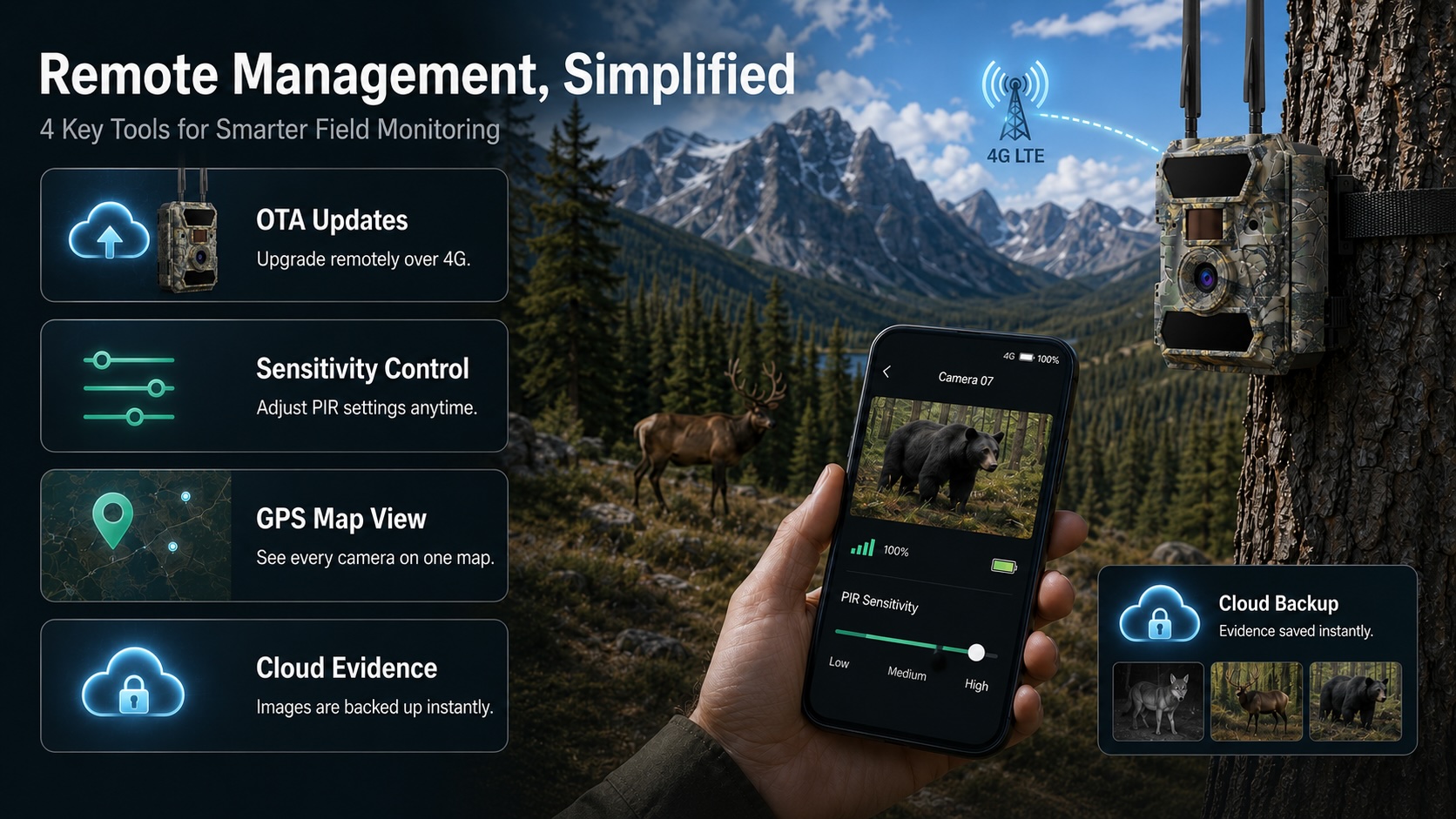
Willfine's app-connected models — the 4.0P-CS, 4.0T-CS, 5.8CS, and T100 Pro — address this through remote management capabilities that reduce the site visit frequency required to keep a camera network functioning:
OTA firmware updates delivered remotely eliminate the need to physically access each camera for software maintenance — relevant for operations where cameras are deployed at locations that require significant travel time to reach.
Remote sensitivity adjustment allows operators to tune PIR trigger sensitivity in response to false alert patterns — reducing vegetation-triggered notifications during high-wind periods, or increasing sensitivity during periods of confirmed threat activity — without visiting the camera location.
GPS location mapping across all cameras in a network enables a land manager to see the geographic distribution of camera coverage, identify gaps, and plan repositioning visits efficiently rather than managing locations from memory or paper maps.
Cloud storage ensures that image records are preserved regardless of what happens to the physical camera — relevant for operations where camera theft or damage is itself a risk, and where the image record may be needed for insurance claims or law enforcement documentation.
Matching the Camera to the Agricultural Use Case
Not every agricultural monitoring application requires the same camera configuration. The threat profile, location characteristics, and management constraints vary enough across different farm contexts that a single camera specification is not optimal for all of them.
For crop field perimeter monitoring — high trigger volume, wildlife focus: The 5.8CG or 5.8CS in compact body format for discreet fence-line placement. 24MP imaging for subject detail. 940nm no-glow for undisturbed natural behavior documentation. App connectivity on the CS variant for remote sensitivity management during high-wind false alert periods.
For remote livestock grazing perimeter — long duration, low maintenance priority: The 5.8T-CG. Cat1 bis low-power modem architecture for maximum standby duration. Approximately 10-month battery life on 8 AA batteries. GPS for location tracking across large grazing territories. Protocol-based SMTP transmission compatible with simple email alert setup.
For equipment and facility security — HD documentation capability: The 4.0T-CS. On-demand HD photo requests at 1920×1440 for license plate and face detail capture. HD video appointment for scheduled high-resolution monitoring during high-risk periods. Cloud storage for evidence preservation. OTA updates for ongoing security feature improvements.
For high-activity monitoring points with AI filtering — feed lots, water points, grain storage: The T200. AI subject classification to filter deer and livestock from human presence alerts. Compact 129×94×76mm body for discreet placement near facility infrastructure. 2K FHD video with audio for comprehensive event documentation.
For multi-site operations requiring network management: The 4.0P-CS or T100 Pro with full Trailcam Ace platform access. GPS location mapping across the camera network. Remote management across all sites from a single app interface. OTA updates across the fleet without site visits.
Product Specification Summary
|
5.8T-CG |
5.8CG / 5.8CS |
4.0T-CS |
T200 |
4.0P-CS |
| Agricultural use |
Remote grazing perimeter |
Crop field perimeter |
Equipment & facility security |
AI-filtered monitoring |
Multi-site network management |
| Connectivity |
Cat1 bis |
Cat.4 |
Cat1 |
Cat1 |
Cat.4 |
| Photo |
32MP |
24MP |
32MP + HD request |
5MP / 2K video |
24MP |
| Trigger |
0.4–0.5s |
0.4s |
~0.4s |
0.4–0.5s |
0.4s |
| Night vision |
60pc IR / 20m |
60pc 940nm / 20m |
940nm / 20m |
54pc 940nm / 20m |
57pc 940nm / 20m |
| Battery |
8 AA · ~10 mo |
8 AA · 6 mo |
12 AA |
8 AA |
12 AA · 5–8 mo |
| GPS |
✓ |
✓ |
✓ |
— |
✓ |
| App / OTA |
TrailCamera App |
CS: Trailcam Ace + OTA |
Trailcam Ace + OTA + Cloud |
Trailcam Ace + OTA |
Trailcam Ace + OTA |
| AI |
— |
— |
— |
✓ |
— |
| HD on demand |
— |
— |
✓ |
— |
— |
| Waterproof |
IP66 |
IP66 |
IP66 |
IP66 |
IP66 |
| Body size |
128×96×76mm |
128×96×76mm |
152×116×72mm |
129×94×76mm |
148×117×78mm |
Who Builds on This Platform
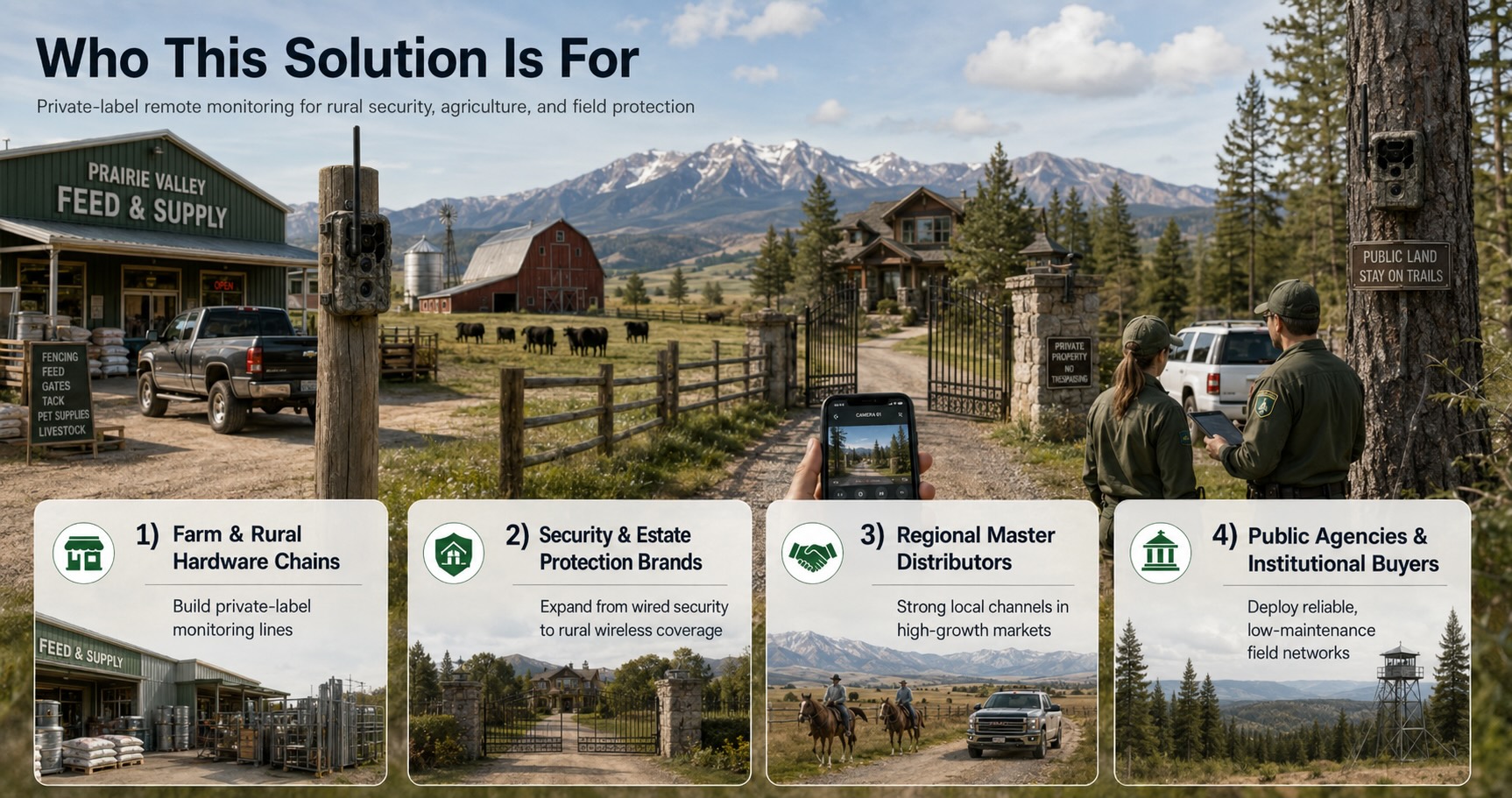
Willfine's agricultural monitoring OEM program serves buyers who bring distribution access into farm supply, rural retail, livestock management, or property protection categories — and need a manufacturing and platform partner who can deliver hardware, app infrastructure, and certification readiness as a complete package.
The program is most relevant for farm supply and rural hardware distributors building a private-label monitoring product line for their existing agricultural customer base; outdoor and property protection brands extending into the agricultural security segment; regional distributors in European markets where precision agriculture and rural property protection are growing investment priorities; and institutional buyers — government agricultural agencies, rural insurance programs, forestry management organizations — that need to instrument large areas with reliable, low-maintenance remote monitoring equipment.
Request the Agricultural Monitoring Platform Brief
OEM evaluation begins with a technical consultation, sample units across the relevant model configurations, and a Trailcam Ace app demonstration. White-label deployment terms and multi-unit OEM pricing are provided under NDA for qualified buyers.
Contact Willfine to request the agricultural monitoring platform brief.

 EN
EN