EN
How to Choose the Right Bird Feeder Camera?

The smart bird feeder category has moved well beyond a basic trail camera bolted onto a plastic hopper. Today, a competitive bird feeder camera product is a fully integrated platform: purpose-built hardware, on-device and cloud-side AI, a polished companion app, cloud storage infrastructure, and a recurring subscription layer. For a brand launching or scaling a smart bird feeder line, selecting the right platform partner—or building the stack in-house—is the single highest-leverage decision you will make. This guide walks through the six dimensions that matter, with real 2026 market benchmarks, so you can evaluate proposals with the rigor they deserve.
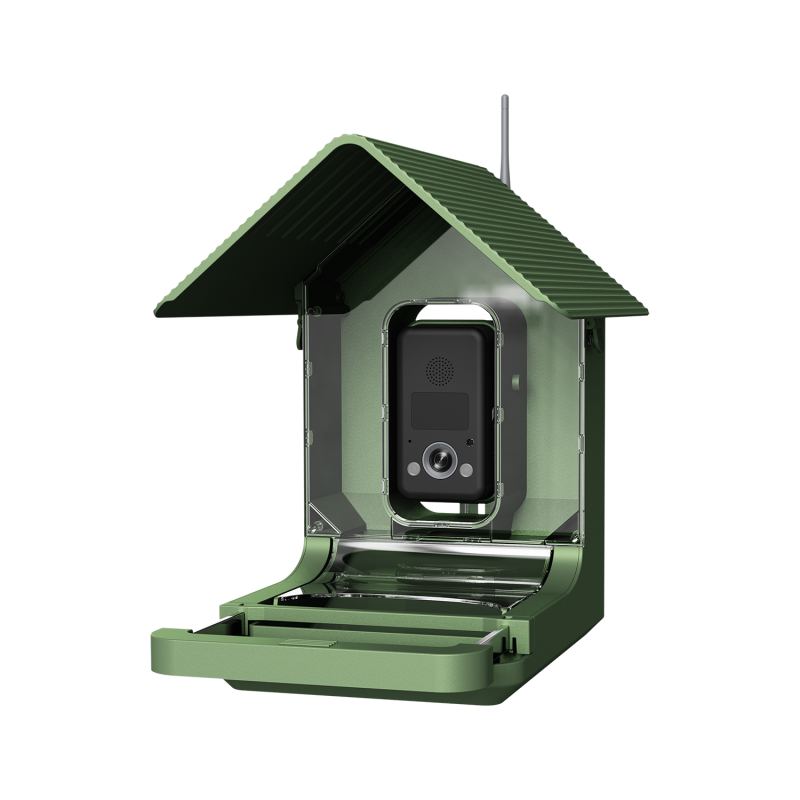
Many buyers make the mistake of treating a bird feeder camera as a hardware SKU—comparing megapixels and price per unit and walking away with a commodity. The reality is that consumer loyalty, review ratings, and long-term margin are decided by the platform behind the device: how accurate the AI is, how often the app crashes, whether the cloud survives a spring-migration traffic spike, and whether the subscription business actually retains customers. The right platform turns a one-time hardware sale into a recurring-revenue brand.
1. Hardware: Beyond Resolution Numbers
Image Pipeline
Resolution matters, but it is only one line on a BOM. Distinguish between sensor resolution and effective output. A bird feeder camera marketed as "4K" may downscale to 1080p for live streaming due to bandwidth constraints. Ask for the sensor size and model (1/2.8" or larger for low-light performance), the effective still resolution versus video resolution, the lens FOV (130°–160° is the sweet spot for a feeder; narrower misses perching birds, wider introduces distortion), and whether HDR is real sensor HDR or digital.
Night Vision
IR wavelength matters. 940nm IR is invisible to birds and humans (no visible red glow), but produces shorter range and darker footage. 850nm IR illuminates farther but has a faint red glow that can disturb skittish species. For a smart bird feeder marketed to suburban birders, 940nm at 5–7m effective range is the expectation.
Power
Solar plus rechargeable Li-ion (typically 4000–5200 mAh across 18650 cells) is table stakes. Ask for the rated runtime per charge under realistic PIR-triggered usage (not "standby time"), the solar panel wattage (5W is baseline; 2W+ minimum for cloudy climates), and cold-weather derating—Li-ion capacity drops sharply below 0°C, and this is the number-one warranty-return driver in northern markets.
Enclosure and Connectivity
IP65 is minimum; IP66 preferred. UV-stabilized ABS is acceptable at entry, but mid- and premium-tier smart bird feeders use aluminum or powder-coated die-cast to survive multi-season exposure. Squirrel-proofing (metal perches, chew-resistant cabling) is increasingly a buyer expectation, not a premium upsell. On connectivity, 2.4 GHz Wi-Fi is baseline; 4G LTE with global-band SIM support is a meaningful differentiator for properties with weak home Wi-Fi—a common pain point. Verify whether the firmware lets users switch between them.
2. AI: The Differentiator That Makes or Retains Customers
Species Database and Accuracy
AI bird species identification is the headline feature consumers pay for, but it is also where platforms vary most in quality. Marketed numbers range from 1,000 to 11,000+ species, but accuracy matters more than catalog size. Ask the platform vendor for a confusion matrix on the common North American and European species your customers will actually see—chickadees, finches, sparrows, woodpeckers. Also confirm whether identification happens on-device (lower latency, lower cloud cost) or in the cloud (larger model, more bandwidth).
False Alerts
This is the number-one negative review theme across every bird feeder camera brand. A motion-only camera can fire hundreds of alerts per day from swaying branches. A competent AI pipeline should distinguish bird-sized objects from non-bird motion and ideally filter by species. If the vendor cannot quote a false-positive rate on leaves, branches, squirrels, and rain, treat that as a red flag.
Continuous Learning and Subscription Dependency
Ask how the model improves over time. The best platforms use anonymized user footage to retrain species models and push OTA updates; avoid vendors that sell you a model frozen at launch. Critically, confirm whether AI identification requires a paid cloud subscription or is available on-device and free—this dramatically affects conversion and retention.
3. App: The Product the Customer Actually Touches
Hardware is unbox-and-forget; the app is where the brand relationship lives. Evaluate whether the platform ships native iOS and Android apps (not a generic WebView wrapper), and check the average rating on both stores—below 4.0 is a warning sign. Review velocity and recency matter too: an app that has not been updated in 12 months indicates a stagnant platform.
Demand these core features: live preview under 2 seconds latency over Wi-Fi, event-based recording with a usable timeline, push notifications with species-level detail, two-way audio (a bonus consumers increasingly expect), family/shared access for multiple household members, and one-tap export to social (a free virality loop). Given the camera is pointed at a customer's backyard, data privacy is a purchase barrier—the app should make clear what is recorded, where it is stored, and offer local-only storage options.
4. Cloud: The Invisible Infrastructure
Cloud is where most underfunded platforms fall over after launch. Ask whether footage is event-triggered cloud recording (preferred—lower bandwidth, lower storage cost), 24/7 continuous recording (high cost, usually paid-tier only), or local SD only (no cloud resilience). If you sell outside the vendor's home market, verify where cloud servers are hosted; EU data residency rules under GDPR may demand EU-based storage, and latency to Asia-Pacific servers will degrade the live-view experience for US customers.
Ask for uptime history, not marketing promises. A cloud outage during spring migration—the highest-usage window—produces angry reviews that take years to recover from. Most importantly, confirm who owns the customer data. If you are white-labeling a platform, make sure you can export your user list and footage, and are not locked into the vendor's subscription billing.
5. Subscription: The Real Business Model
Hardware margins in this category are thin. The long-term value of a smart bird feeder line is recurring subscription revenue. As of 2026, leading platforms charge roughly $5–$10 per month or $60–$100 per year for AI identification plus cloud storage, with a free tier that typically offers 3–7 days of rolling cloud storage and basic alerts. Do not underprice the subscription to differentiate—consumers already expect a subscription layer; the decision is whether yours is worth paying for.
Questions to ask your platform partner: what revenue split do they offer on subscription, can you set your own pricing, what is the typical free-to-paid conversion rate (healthy benchmarks are 5–15%), and is there an option for a one-time "lifetime" license to close price-sensitive buyers.
6. Manufacturing and Scale: Can They Actually Deliver?
A beautiful reference design is meaningless if it cannot ship at quality. Before sampling, confirm the platform holds FCC (US), CE/RoHS (EU), UKCA, PSE (Japan), and battery UN38.3 for air freight. Ask for the IP rating test report, not just the datasheet claim.
Typical OEM terms for a smart bird feeder: MOQ of 500–2,000 units for white-label, lower for established ODM platforms; tooling already absorbed by off-the-shelf reference designs, with $5,000–$30,000 for cosmetic customization; lead time of 45–75 days after deposit. Demand incoming QC, in-line QC, and pre-shipment AQL inspection reports. Warranty terms of 12 months are standard; ask for the out-of-warranty repair cost. Decide your customization depth up front: logo-only is fastest and cheapest, while hardware modification (sensor swap, battery size, enclosure redesign) means higher MOQ, longer lead time, and more engineering risk.
Price Realities to Anchor Your Business Case
A common mistake is overestimating what consumers will pay. Based on current 2026 retail data, value-tier bird feeder cameras sell for $30–$120, mainstream mid-range products with 2K resolution, solar, AI identification, and a mature app sell for $130–$260, and premium flagships with 4K, multi-lens, metal housing, and 4G top out around $240–$360. Consumer products priced above $400 are rare in this category, and $600–$800 claims do not reflect the current retail market. Plan your BOM to land in the $130–$260 retail band for the highest volume.
Remember that brands commonly list an MSRP 30–50% above actual selling price. Plan margin around the street price, not the sticker. OEM cost at mid-volume typically runs 30–50% of retail—roughly $15–$50 for entry, $40–$80 for mainstream, and $70–$120 for premium—though actual quotes vary by vendor and MOQ and should be confirmed directly.
FAQ
What is the minimum order quantity for a white-label smart bird feeder?
Most ODM platforms in this category start at 500–1,000 units for logo-and-packaging customization. Hardware-level changes typically require 2,000+ units. Plan a pilot batch before committing to full-volume orders.
Should we build the app and cloud ourselves, or use a white-label platform?
Building in-house costs $100,000–$500,000+ in engineering and 12–18 months before launch. A white-label platform gets you to market in 60–90 days but takes a cut of subscription revenue. Choose in-house if subscription margin and brand differentiation are your long-term bet; choose white-label if speed-to-market matters more.
How important is 4G versus Wi-Fi only?
Wi-Fi-only covers roughly 80% of suburban backyards. 4G opens rural, cabin, and large-property customers and justifies a $50–$100 premium. If your target market includes rural birding enthusiasts, 4G is worth the BOM cost.
What is a realistic subscription conversion rate?
Healthy products see 5–15% of hardware buyers convert to paid annual subscriptions. Track this as a key performance indicator from launch—hardware units without subscription attach rate are a much weaker business.
How do we verify AI species-identification accuracy before ordering?
Request a pilot unit and test it against the 10–20 bird species most common in your target market. Count true identifications, false positives, and misses. Do not rely on vendor demo videos; test in your own backyard.
Evaluating a smart bird feeder camera platform is not a procurement exercise—it is a partnership decision across hardware, AI, software, cloud, and manufacturing. Resist the temptation to select on hardware specs alone; the app, cloud reliability, and subscription economics will determine retention and LTV long after the unboxing review is forgotten. Benchmark every proposal against the price bands and capability expectations above, pilot before committing, and design your margin around the real street price, not the inflated MSRP.