EN
Designing Telecom-Grade Cellular Trail Cameras: SIM Management, Network Bands, and Cloud Economics for OEM Brands

For outdoor technology brands, security distributors, and hunting equipment OEMs, scaling a cellular trail camera catalog involves much more than selecting a image sensor and plastic housing. In the modern connected hardware ecosystem, cellular cameras are specialized Machine-to-Machine (M2M) telecommunication endpoints. The technical architecture choices made during initial product scoping directly govern monthly carrier telemetry expenses, firmware stability, global network compatibility, and long-term recurring SaaS revenue.
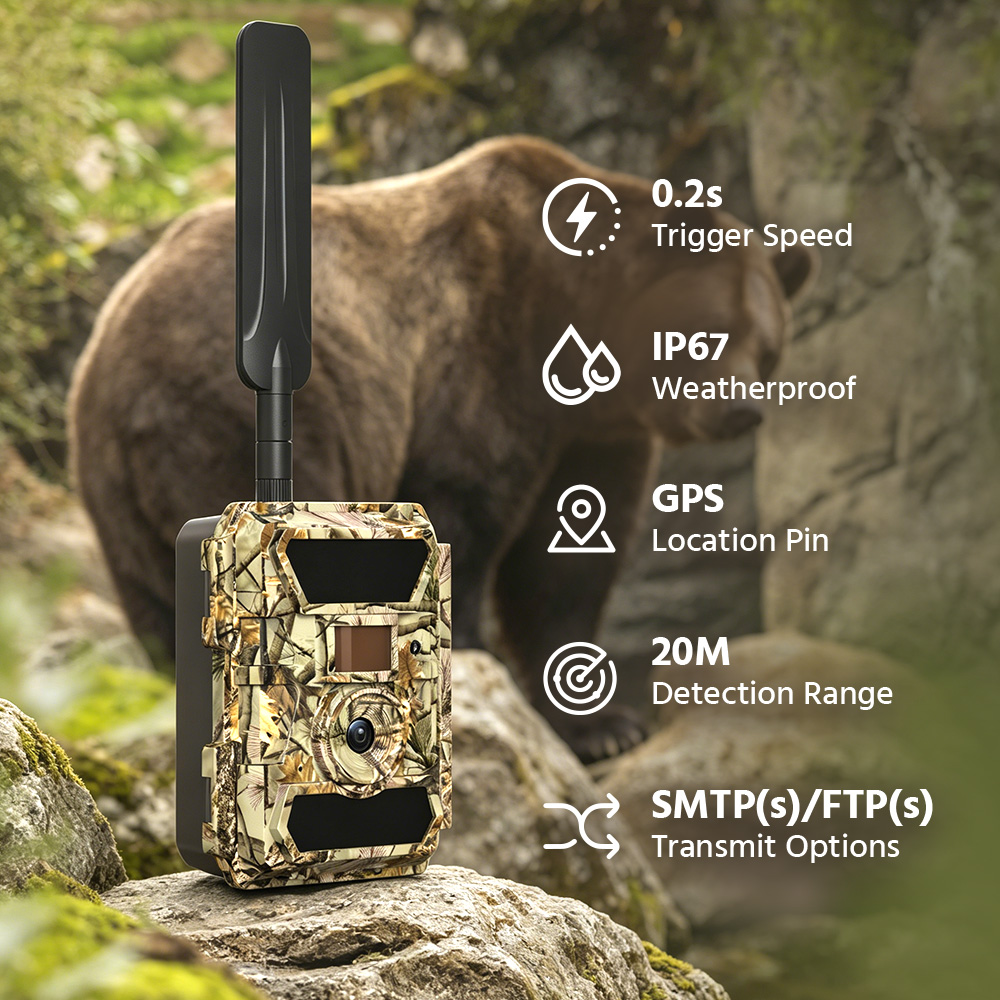
Selecting a manufacturing partner requires product teams to evaluate how modem engineering, network topology, and SIM management platforms function as an integrated ecosystem. This guide outlines the key telecommunication and hardware architecture dimensions brands must verify before launching an OEM or ODM cellular trail camera line.
1. RF Engineering and Global Cellular Band Compatibility
Cellular trail cameras must establish reliable RF connections across remote wilderness areas where tower signal strength is notoriously weak.
Multi-Carrier Carrier Auto-Switching: Hardware should integrate e-SIM or multi-carrier SIM chipsets capable of automatically selecting the strongest local tower (such as AT&T, Verizon, or T-Mobile in North America, or Vodafone and Deutsche Telekom in Europe).
Global Carrier Band Certification: Ensure the supplier’s cellular modems hold official PTCRB, FCC, CE, and RED approvals. Modems must support regional LTE-M (Cat-M1) and NB-IoT for low-power snapshot transmission, as well as LTE Cat-1/Cat-4 for high-bandwidth real-time streaming.
Antenna Isolation and Gain: High-gain, multi-band external omnidirectional antennas must be impedance-matched to prevent internal RF interference with motion detection microcontrollers.
2. Network Topology Selection: Standalone 4G vs. Localized Mesh Gateways
Selecting the optimal network topology depends heavily on the target deployment environment and the user’s total cost of ownership (TCO).
Standalone Cellular Nodes: Products like WILLFINE’s Smart 4G LTE Exquisite Trail Camera and 4G Cellular Security Camera integrate direct 4G LTE modems. They are ideal for standalone perimeter security, remote gate monitoring, or high-priority wildlife locations where a single camera operates independently.
Mesh Gateway Networks (HiF-Mesh): Deploying multiple individual cellular subscriptions across vast forest tracts or agricultural farms rapidly becomes cost-prohibitive. Advanced platforms like WILLFINE’s HiF-Mesh Trail Camera System resolve this bottleneck. Multiple low-power sub-cameras form a localized wireless radio mesh, relaying captured image data to a single 4G solar host unit. This multi-node topology allows users to monitor wide acreage using only one active SIM data plan.
3. Video Codec Compression and Live-Stream Data Pipeline
Data transfer costs paid to telecom carriers represent the single largest variable operating expense for cellular camera platforms.
Adaptive Bitrate Live Streaming: Real-time viewing capabilities—featured in models like the Live Stream 4G Cloud Trail Camera—require H.265 (HEVC) video compression algorithms paired with dynamic bitrate scaling. H.265 delivers up to 50% bandwidth savings compared to legacy H.264 codecs without degrading visual resolution.
Dynamic Pipeline Resolution Adjustment: Firmware should automatically drop live streaming parameters to lower bitrates under weak cellular signal conditions, preventing connection timeouts and frame stuttering.
4. Edge AI Filtering: Protecting Cloud Margin and Power Reserves
False motion triggers caused by blowing grass, shadows, rain, or falling leaves drain battery reserves and inflate cloud data transfer bills.
By implementing embedded Edge AI processing—as deployed in WILLFINE’s AI-Powered 4G Trail Camera—the camera analyzes PIR motion events locally using lightweight neural networks. The 4G modem is powered up only when a verified target (such as a human intruder, vehicle, or game animal) is detected. This local filtering suppresses up to 90% of empty trigger transmissions, conserving cellular data allowances and dramatically extending field battery life.
5. White-Label SIM Management Portals and SaaS Revenue
For private-label brands, the true value of a connected camera platform resides in the software layer.
A turnkey ODM platform should provide brands with a dedicated, white-label SIM and device management portal. This software allows brands to:
· Manage e-SIM provisioning, data pool allocation, and carrier activation across thousands of fielded units.
· Package custom end-user subscription tiers (such as pay-as-you-go photo top-ups, recurring monthly video plans, or multi-camera fleet passes).
· Maintain complete ownership over user account databases, cloud video storage rights, and over-the-air (OTA) firmware update distribution.
Partnering for OEM/ODM Success
Building a scalable, telecom-grade cellular camera line requires balancing RF module design, power management, Edge AI filtering, and cloud subscription portals.
WILLFINE is a trusted technology platform partner specializing in advanced outdoor imaging solutions. Its versatile product line—including compact 4G units, live-streaming cloud cameras, AI-driven trail cameras, 4G solar security cameras, and the innovative HiF-Mesh system—provides complete turn-key OEM/ODM customization. Supported by accessible MOQ requirements (100–200 units for logo branding; 500 units for custom packaging), WILLFINE helps global brands deploy high-margin connected camera lines efficiently.