EN
EN
The Camera Sees Everything. Now It Can Tell You What It Sees.

A research-oriented look at how AI-driven species identification converts passive wildlife imagery into structured ecological data — and what that shift means for conservation, agriculture, and field research programs.
The problem with passive monitoring
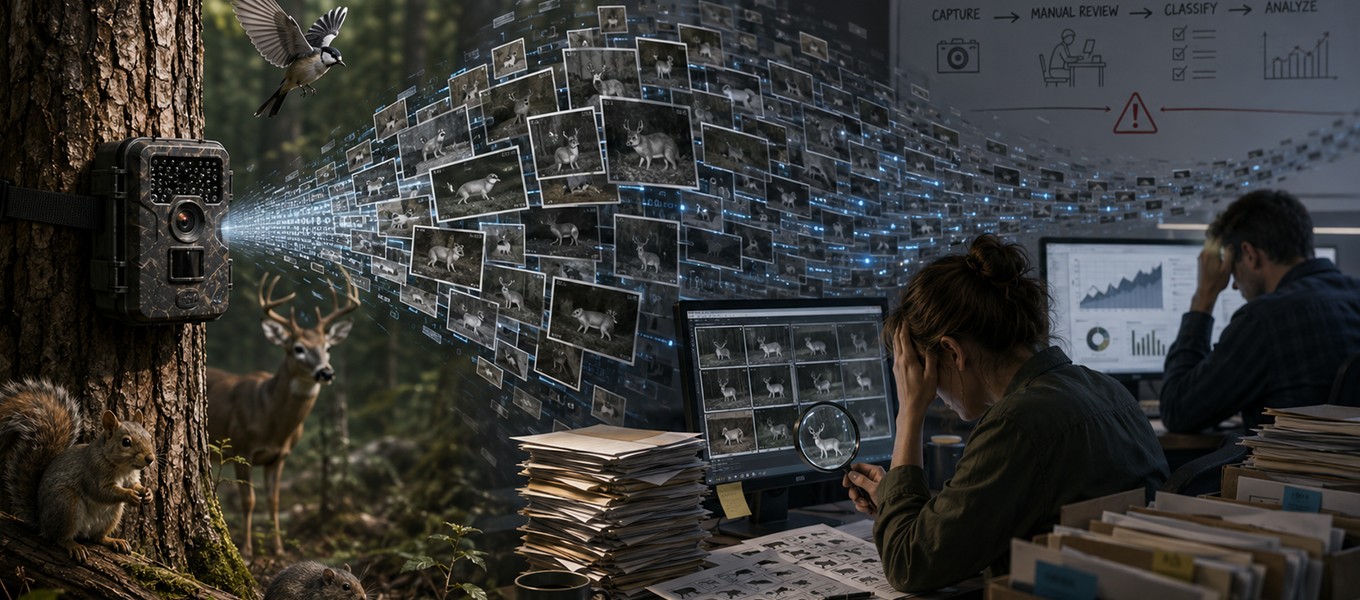
Wildlife monitoring has always produced more raw data than organizations can process. A single camera deployed across a season may trigger tens of thousands of times — generating an image archive that is valuable in principle and unmanageable in practice.
The traditional response is labor: hire technicians to review footage, train volunteers to classify species, or accept that large portions of the data set will never be systematically examined. None of these approaches scale. Conservation organizations operating across wide territories, research institutions running multi-site studies, and agricultural operators monitoring large land parcels all face the same constraint — the bottleneck isn't the camera. It's everything that happens after the shutter fires.
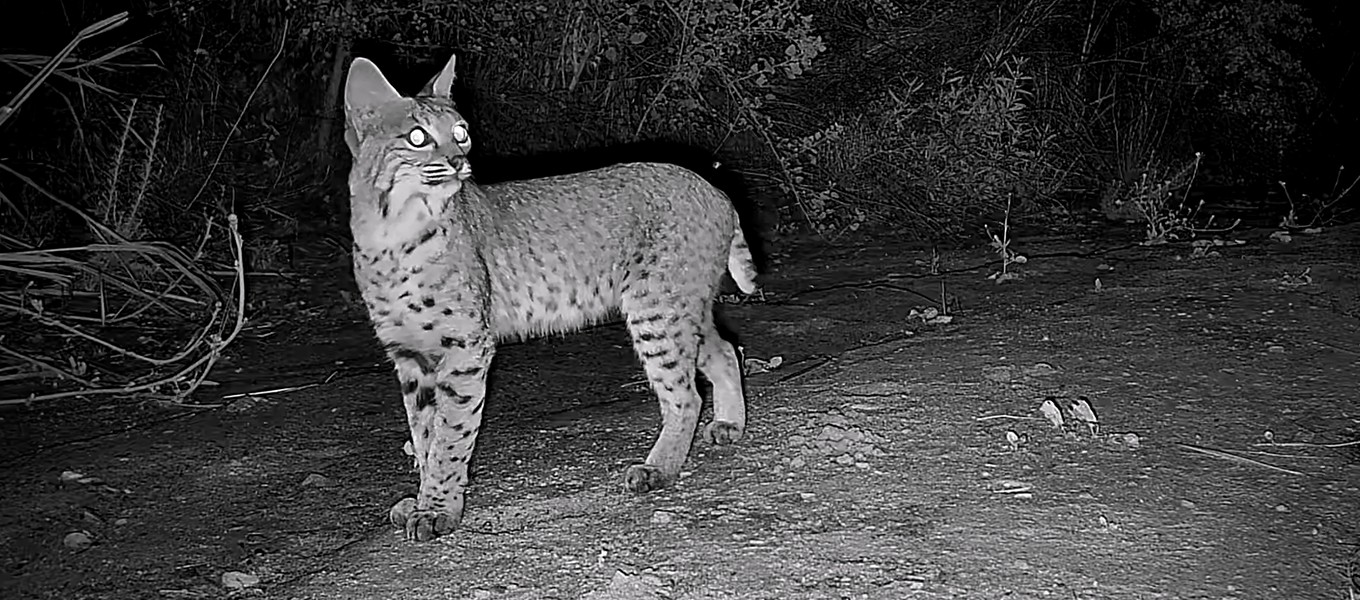
AI-powered species recognition does not simply speed up that review process. It eliminates the bottleneck entirely by moving identification to the moment of capture. When a camera detects motion and triggers an image, the recognition engine analyzes that image before it is transmitted — returning a species identification, logging the event, and initiating any configured alerts within seconds. No queue. No backlog. No manual review as a prerequisite for insight.
The meaningful shift is not speed — it is the structural change from reactive review to continuous, real-time ecological intelligence. The data becomes actionable at the moment it is generated.
How Willfine's identification engine is built
Willfine's system is built on a deep learning and neural network architecture trained against a large, geographically diverse labeled dataset. The model has been developed to handle the practical conditions of field deployment — variable illumination across dawn and dusk cycles, partial subject occlusion by vegetation, inconsistent camera angles, and the wide range of image quality that results from motion-triggered capture in uncontrolled environments.
The recognition engine is integrated into the camera platform rather than operating as a downstream post-processing step. This architectural choice matters: it means identification results are available in time to drive the alert and data logging pipeline, not after a separate processing cycle has completed.
01 — Neural network identification Deep learning model trained on an extensive labeled dataset covering 10,000+ bird and animal species. Handles common and rare varieties across diverse habitat and lighting conditions.
02 — At-capture analysis Identification runs at the moment of image or video capture, not in a queued batch. Enables the notification and data pipeline to operate without manual review as an intermediate step.
03 — Adaptive species database The recognition database spans more than 10,000 species across birds and mammals globally. Automated updates expand coverage and refine model accuracy as new training data becomes available.
04 — Configurable target notifications Define target species — endangered animals, crop pests, invasive arrivals — and receive push alerts only when a relevant identification occurs. Reduces notification volume and alert fatigue.
One design priority that distinguishes the Willfine system from generic computer vision approaches is the focus on field-condition accuracy rather than controlled-environment benchmarks. A model that performs well on clean, well-lit studio images is not the same as a model that performs reliably on a motion-blurred frame taken at 3 a.m. by a camera mounted on a fence post. The training dataset and evaluation criteria reflect that distinction.
Where automated identification changes operational outcomes
The value of species identification is downstream of the identification itself — in the decisions and actions it enables. The following domains represent the primary contexts where Willfine's system integrates into meaningful workflows rather than functioning as an isolated feature.
| Domain | How identification changes what is operationally possible |
| Conservation | Research teams monitoring endangered or threatened species can deploy cameras across large or difficult-to-access territories and receive verified identification alerts without reviewing every triggered frame. Population occurrence data accumulates automatically in formats exportable to standard ecological databases and research tools. |
| Agriculture | Automated recognition of pest species allows land operators to respond to specific confirmed threats rather than conducting labor-intensive physical inspections. Identification logs with timestamps and location data support intervention timing decisions and provide an evidence base for efficacy tracking. |
| Risk & Habitat | Early identification of invasive species or wildlife approaching human activity zones enables intervention before ecological or safety thresholds are exceeded. The identification timestamp and geolocation data build an audit record that supports habitat management planning and regulatory documentation. |
| Research | Longitudinal behavioral studies require sustained, consistent data collection over extended periods. Automated identification makes it cost-feasible to maintain that continuity across multi-season deployments without proportional increases in review labor — enabling study designs that were previously impractical at scale. |
A pattern runs across all four domains: the identification event is the trigger, not the output. What the system ultimately delivers is structured occurrence data — timestamped, species-classified records that feed into analysis, reporting, and decision workflows. The Willfine platform surfaces those data outputs through its analytics layer, without requiring technical configuration from end users or researchers.
Deployment and integration parameters
For organizations evaluating automated wildlife monitoring systems, the relevant assessment covers recognition performance alongside integration requirements. The following parameters support deployment planning and procurement evaluation.
| Parameter | Specification |
| Species coverage | 10,000+ bird and animal species |
| Analysis timing | Real-time — at point of image or video capture |
| Input media | Still image and video |
| Alert delivery | Push notification via app or connected communication channel |
| Alert targeting | Configurable per-species filtering — notifications for defined target species only |
| Database updates | Automated — coverage expansion and model refinement over time |
| Data outputs | Occurrence logs, population trend analytics, behavior pattern statistics |
| User interface | No specialist training required — results accessible via standard app interface |
Building on the Willfine platform
Willfine's species identification technology is available both as an integrated feature of Willfine hardware and as a platform component for OEM partners and institutional buyers developing their own wildlife monitoring systems. For partners building on the platform, the relevant capabilities extend beyond the recognition engine:
— Species identification engine with API access for integration into existing research platforms, ecological databases, and third-party data pipelines
— Configurable alert parameters and target-species definitions adjustable per deployment without firmware modification
— Analytics dashboard with exportable occurrence and trend data in formats compatible with standard ecological research tools
— Automated model updates delivered without device downtime — recognition accuracy improves across the deployment lifecycle
— White-label app deployment for partners building a branded wildlife monitoring product on Willfine infrastructure
— Dedicated server environment for institutional deployments — no shared infrastructure with competing programs
The identification layer is not a feature — it is the mechanism that converts a passive image archive into a continuously updated record of ecological activity. That record is what makes a monitoring program genuinely useful at the scale that conservation and research work requires.
Evaluate the system for your monitoring program
Whether you represent a conservation organization, a research institution, an agricultural operation, or an OEM partner developing a branded solution, Willfine provides technical documentation and product demonstration for qualified inquiries.
Contact Willfine to request the technical brief and OEM program details.